Works on: Windows 10 | Windows 8.1 | Windows 8 | Windows 7 | Windows XP | Windows 2000 | Windows 2003 | Windows 2008 | Windows 98 | Windows ME | Windows NT | Windows Vista | Windows 2012 SHA1 Hash: cc5179fa05a6173116273f3a300deb0c95a5bc26 Size: 1.93 MB File Format: zip
Rating: 2.4
out of 5
based on 23 user ratings
Downloads: 199 License: Free
FEMCon is a free software by Goethe University and works on Windows 10, Windows 8.1, Windows 8, Windows 7, Windows XP, Windows 2000, Windows 2003, Windows 2008, Windows 98, Windows ME, Windows NT, Windows Vista, Windows 2012.
You can download FEMCon which is 1.93 MB in size and belongs to the software category Home and Education. FEMCon was released on 2012-04-02 and last updated on our database on 2017-04-23 and is currently at version 1.
Thank you for downloading from SoftPaz! Your download should start any moment now. It would be great if you could rate and share:
Rate this software:
Share in your network:
FEMCon Description
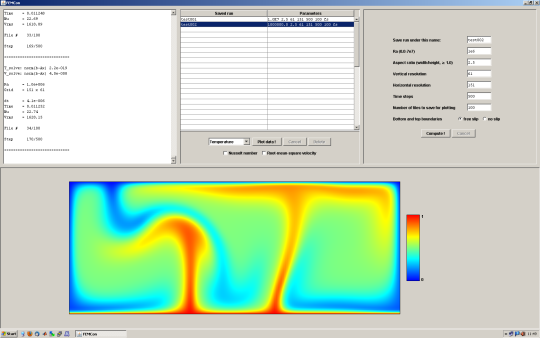
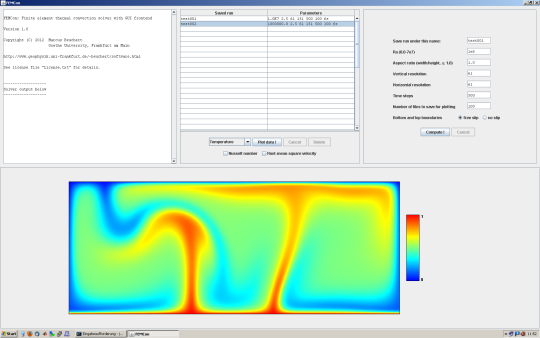
FEMCon is an interactive tool that lets you explore thermal convection in a nutshell. Why are Geoscientists interested in thermal convection? Thats because the Earths mantle is slowly convecting (mantle convection) due to high thermal gradients at the core-mantle boundary and at the Earths surface. Mantle convection is the driving mechanism for all the dynamic processes we observe at the Earths surface and which make our planet so special: continental drift, moutain building, volcanism, earthquakes, ... all of those processes are in the end all related to thermal convection of the Earths mantle. So its important to understand how it works.After choosing a set of parameters, FEMCon solves the incompressible thermal convection equations for a viscous fluid using the Finite Element Method (FEM). FEMCon consists of a fast thermal convection solver written in C and a Java GUI frontend that serves to visualize the results. FEMCon gives you an easy way of exploring (1) how the connectivity of a system depends on the Rayleigh number and (2) how the results depend on the choice of numerical parameters.FEMCon computes the two most important quantitative geophysical measures characterizing a thermally convecting system, namely the Nusselt number and the root-mean-square velocity, throughout the simulations. Plotting the time evolution of those parameters along with temperature or velocity fields gives you a good feel about how the system evolves depending on the Rayleigh number.



 Windows NT and above
 View Screenshots(3)
 Comments
 Download




 Similar Software


 Recently Searched
 Software Categories
 Trending Software

 Like Us

